
More Data, More Problems
Tracking everything, understanding nothing — and the need for Health Intelligence.
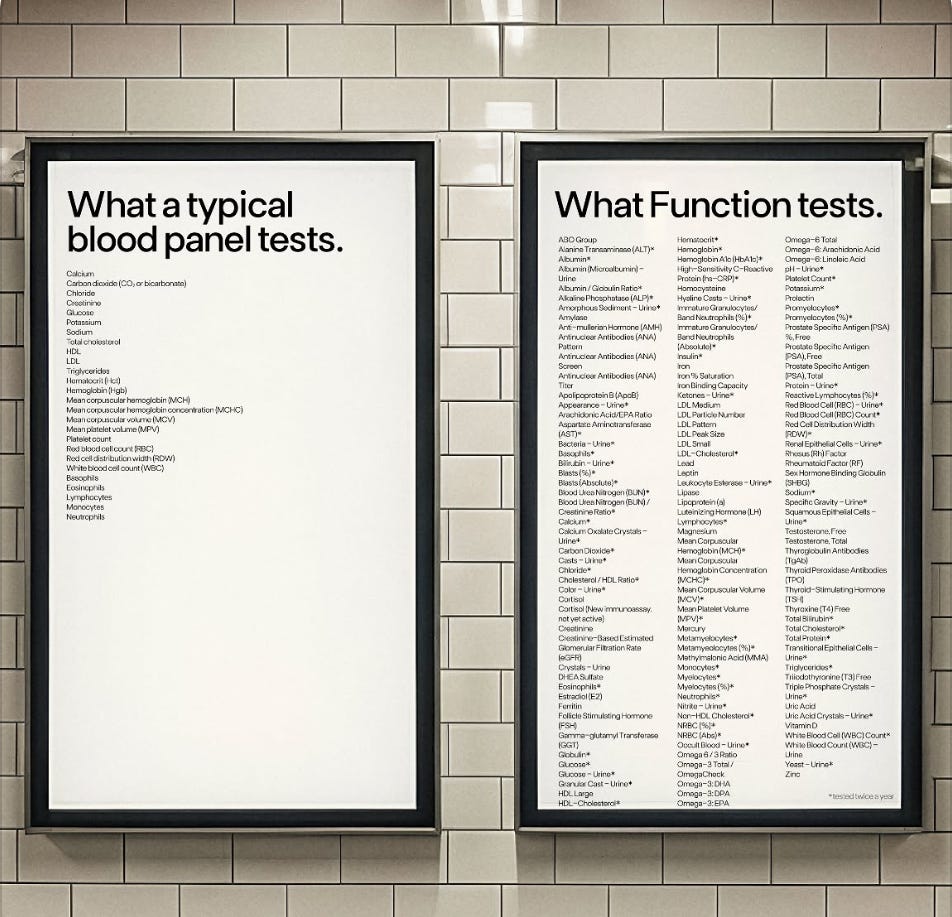
Health data is having a major moment and the numbers say it all.
Whoop just raised $575 million. Function Health closed its latest round at a $2.5 billion valuation.
Clearly we are living in the golden age of self-monitoring.
Your ring tracks your sleep cycles. Your watch counts your steps. Your blood panel tests for 160 biomarkers. There’s an app for your macros, a device for your glucose, and AI on standby 24/7 to play doctor.
And somewhere in Silicon Valley, someone launched a toilet that tracks your bowel movements. Apparently, no bodily function is too intimate to quantify.

As a former CMO, I’m mostly excited by all of this. The healthcare system, especially for women in midlife, has been underserving us for decades. It’s about time we have more control over our health.
But more information doesn’t guarantee more clarity. In some cases, it just creates more confusion — and a wellness industry ready to sell you a solution for every new problem it helped to create.
My clients are among the most health-literate people in the room. But lately they all seem to arrive at the same place:
I have all this data. I don’t know what to do with it.
The pendulum has swung too far. Our doctors, for all their limitations, ordered tests with a question in mind. The wellness industry sells you tests with a product in mind. The data might be the same but the intention is completely different.
It seems we removed the medical gatekeeper and replaced her with a shopping cart. When every metric becomes a problem, every problem becomes a purchase.
Here’s something I tell my clients that reframes their “more is more” approach.
Health data isn’t only what you can measure. Your symptoms are signals — and they can be just as diagnostic as any number on a panel. Your body is speaking to you so it’s time to listen.
Our access to information has outpaced our ability to interpret it.
Let’s use the example of AI. Anyone can subscribe to Claude or ChatGPT to theoretically have access to infinite information. But the people who know how to prompt it with precision, challenge it with discernment, and turn the output into action? They get the most out of the same tool.
Health metrics work exactly the same way.
The average American spends over $6,000 a year towards their wellness1. Health enthusiasts often spend double. But the ones who reach their goals or have better outcomes aren’t necessarily spending or doing more — they just have a personalized strategy.
It’s not what you know. It’s what you do with it.
It’s not how much you spend. It’s your return on investment.
This is what I call Health Intelligence. The difference between collecting data and wielding it.
📢 Introducing The Health Intelligence Audit™
After years of coaching high-performing women and advising leading wellness brands, I had a realization — I was doing the exact same thing in both rooms. Decoding the data. Identifying the goals. Building a strategy with clear priorities and measurable outcomes.
Your health deserves the same quality of thinking you bring to your business. That’s exactly what The Health Intelligence Audit™ delivers.
It’s the starting point where we look at your quantitative data (labs, scans, biomarkers), your health history (symptoms, habits, lifestyle) and the context that makes it all mean something.
It’s an intensive strategy container that prioritizes and sequences everything in the right order. And, sometimes that means doing less.
You leave with a personalized Health Intelligence Brief™ and a framework that ensures every health decision after it makes more sense.
This is the insider advantage. The one that makes everything else you’re already doing actually work.
Global Wellness Institute “US Wellness Economy Surges to $2.1 Trillion, Cementing Global Leadership”